One of the long-standing objections levelled against the Qur'ān by its non-Muslim critics is that it appears to have no regular form or structure. It is said that its verses follow one another with little sense of interconnection and its sūrahs seem to have been arranged in a sequence based on the crude principle of diminishing length, the longest coming first and the shortest going to the end. Almost every sūrah, it is complained, is riddled with unsettling shifts of scene, address, and subject and one cannot with any amount of certainty predict what is going to come next. It is concluded that the Qur'ān is, at best, a remarkable compilation of unrelated passages, or a book of quotations. That though it is full of pearls, the pearls are lying in a promiscuous heap.
The actual words used by those who have raised this objection are much more stern and caustic. We will not quote them, partly because they may be found in any book written on the Qur'ān by any critic of Islam and partly because their pungency does not add to the gravity of the objection. We shall only note that new as well as old orientalists have made the point often and that for all the difference in their approaches to the Qur'ān, they are all agreed that the Qur'ān completely lacks anything of the kind of orderly arrangement. Some of them have actually tried to rearrange the Qur'ān either chronologically or according to some other self-devised principle.
The response of Muslim scholars to this objection has been, generally, concessive. They grant that the Qur'ān does not have the arrangement of a well-planned book, but then, they say, it was never meant to have one. The revelation of the Qur'ān, they point out, was completed in twenty-three years and during that period the Qur'ān dwelt on such a large number of diverse subjects that no act of compilation could have given it greater unity and coherence than that it now possesses. The Qur'ān, they say, dealt with the lives, activities, and problems of a whole nation for a long span of time and so any objection based on the concept of a research thesis is bound to be misplaced. Read the rest here.
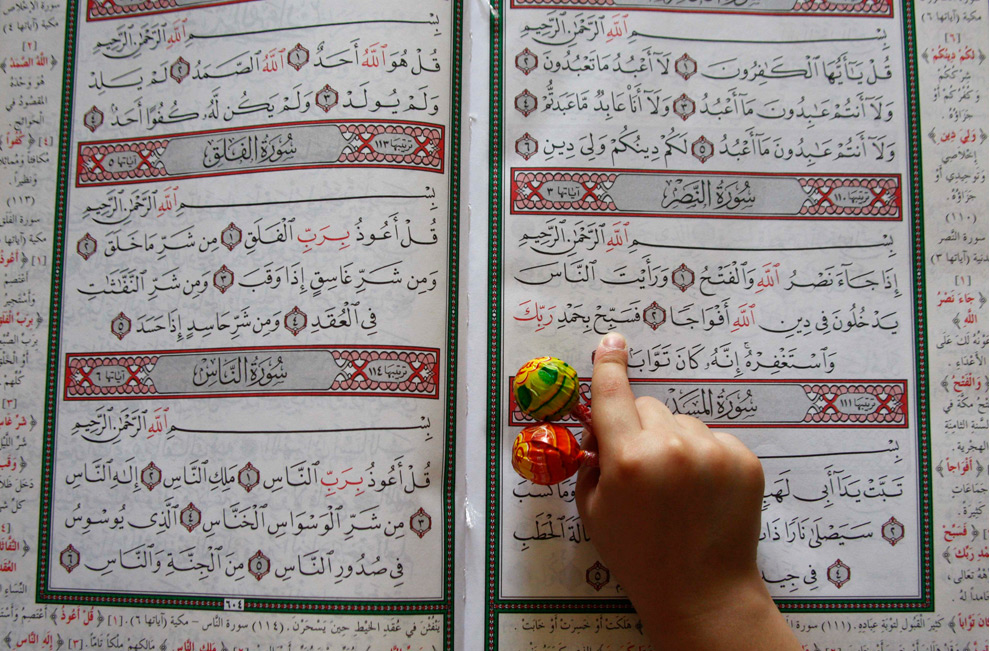
A boy after my own heart. I really do heart the source of these beautifully mesmerising images. How adorable. SubhanAllah.
A boy holds candy in his hand as he reads the Quran in a mosque during Ramadan, in Amman, Jordan on August 22, 2009. (REUTERS/Ali Jarekji (JORDAN RELIGION SOCIETY IMAGES OF THE DAY)
Quote of the day:
Do not ask Allah to guide your footsteps, if you are not willing to move your feet. ~Unknown.
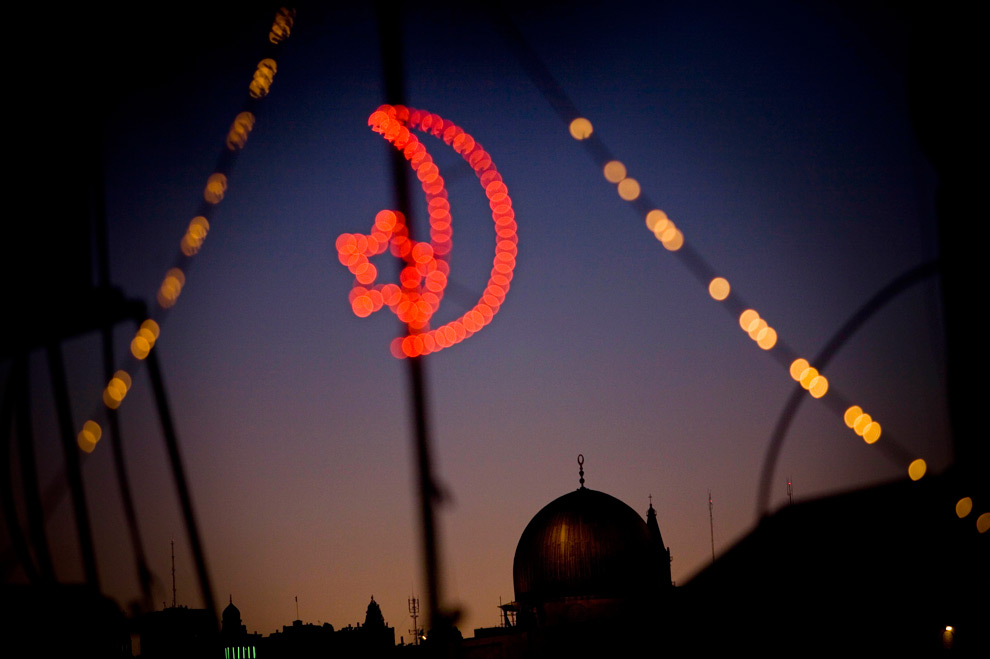
The Dome of the Rock, or Masjid Qubbat As-Sakhrah, one of the holiest sites in Islam, is seen on the Temple Mount in Jerusalem through festive lights for Ramadan on Tuesday, Aug. 25, 2009. (AP Photo/Bernat Armangue)
On the blessings of Laylatul Qadr
The Night of Power is a very important occasion in Islam. Everyone is asked to live it and to enjoy it. This Night is a night of Mercy, a night of Blessing, a night of Peace and a night of Guidance. It is a night of Unification between the finite world of ours and the Infinite Universe of the Unseen. Anyone who is interested in attaining the Mercy of Allah will strive very hard to look for the Night of Power. Anyone who is interested in receiving the blessings of Allah on the Blessed Night will work very hard to enjoy the Night of Power. Anyone who is interested in attaining peace of mind, peace of body and peace in society, he has to look for this Night and to live it.
The month of Ramadan contains the most blessed month of the year, since it contains Laylatul-Qadr, the night when Allah (SWT) chose to reveal the Holy Qur’an.
“We have indeed revealed this (Message) in the Night of Power. And what will explain to thee what the night of power is? The Night of Power is better than a thousand months. Therein descends the angels and the Ruh (Jibrail) by Allah’s permission with all Decrees. There is peace until appearance of dawn” (Al- Qadr 97:1-3)
Worship performed in this night brings more reward than the worship performed in one thousand months. Allah also says about this powerful night in Surah Dukhan
“Ha. Mim. By the book that makes things clear. We sent it down on a blessed night (the Night of Al-Qadr) in the month of Ramadan. For We (ever) wish to warn (against evil). In that (night) is made distinct every affair of wisdom, by command, from Our Presence. For We (ever) send (revelations), as a mercy from Thy Lord for He hears and knows (all things).” (Surah Dukhan 44:1-6)
Salmaan (RA) reported that on the last day of Sha'baan the Messenger of Allah (SAW) addressed them and said
"Oh people, there comes before you now a great month, a most blessed month in which lies a night greater in virtue than one thousand months; (LAYLATUL-QADR). It is a month in which each day should be observed by fasting, this has been made obligatory by the Almighty Allah."
Abu Huraira related that the Prophet (SAW) said
“Whoever fasts during Ramadan with faith and seeking his reward from Allah will have his past sins forgiven. Whoever prays during the nights in Ramadan with faith and seeking his reward from Allah will have his past sins forgiven. And he who passes Lailat al-Qadr in prayer with faith and seeking his reward from Allah will have his past sins forgiven.” [Bukhari, Muslim]
In search for Laylatul Qadr
Allah (SWT) has hidden the knowledge of its occurrence from His servants out of mercy for them so that they can increase their actions in the search for it during these honorable nights, by praying, making dhikr, reciting the Qur’an and supplicating an so they grow and increase in the nearness to Allah (SWT) and His reward. Allah (SWT) also kept it hidden from them as a test for them to distinguish who amongst them struggles and makes an effort to find it and who is lazy and negligent. This is since whoever constantly strives for something, he will exert himself in his search for it and trouble himself in finding it and achieving it.
The signs of the Night of Al-Qadr include 1. The sun rises early in the morning without rays. 2. Rain may fall either during the night or during the day of that night. 3. During night the sky will be lightly foggy. 4. The sky will be slightly lighted without reflections and without rays.
Allah (SWT) discloses the time of the occurrence of the Night of Al-Qadr to some of His servants through signs and signals, which one is able to see, Just as the Prophet (SAW) saw its sign that he would be prostrating in mud on its following morning. So it rained on that night and he prayed the (following) morning (Fajr) prayer in mud [Shaikh Muhammad Ibn Saalih al-'Uthaimin in his book Majaalis].
Based on the saying of the Prophet (SAW), this incredible night falls in the last ten nights of Ramadan,
"Search for the Night of Al-Qadr in the last ten nights of Ramadan." [Al-Bukhari and Muslim]
And it falls in one of the odd nights more likely than on the even nights, based on the Prophet's (SAW) saying
"Search for the Night of Al-Qadr in the odd nights of the last ten nights of Ramadan." [Al-Bukhari]
And it is closer to the last seven nights, based on the hadith of Ibn 'Umar (RA) that
“Some men from the Companions of Allah's Messenger (SAW) saw the Night of Al-Qadr in a dream during the last seven nights (of Ramadan). So the Prophet (SAW) said: 'I see that all of your dreams agree that it (the Night of Al-Qadr) is in the last seven nights. So whoever wants to search for it, then let him search for it in the last seven nights.” [Al-Bukhari and Muslim]
And it is also based on the hadith in Muslim from Ibn 'Umar (RA) that the Prophet (SAW) said
"Look for it in the last ten nights. But if one of you becomes weak or is unable, then do not let the remaining (last) seven nights overcome him."
Amongst the odd nights in the last seven nights, it is closest to the twenty-seventh night due to the hadith of Ubay Bin Ka'ab (RA) who said
“By Allah, I know which night it is. It is on the night that Allah's Messenger (SAW) commanded us to perform the Night Prayer. It is on the twenty-seventh night.” [Muslim]
The night of Al-Qadr is not specified to one fixed night throughout all the years. Rather, it constantly changes. So one year it could occur on the 27th night for example and on another year it could occur on the 25th night, according to Allah's Will and Wisdom. What directs us to this is the Prophet's (SAW) saying
"Look for it (i.e. the Night of Al-Qadr) when there remain nine nights, when there remains seven nights, or when there remains five nights (i.e. 21st, 23rd and 25th respectively without mention of the 27th)."
Al-Hafidh Ibn Hajr said in Fath-ul-Bari "the most strongest opinion is that it is on an odd night in the last ten nights and that it constantly changes."
Salaam readers I've been meaning to write a post on Ramadhan in general for some time now but more specifically regarding the Night of Power, or Laylat al Qadr. So at long last it is here. I hope you find it as informative and inspiring as I did, also please excuse me if it is some what sparse. I've copied and referenced what I have found personally useful.Refs for both posts. Jzk.
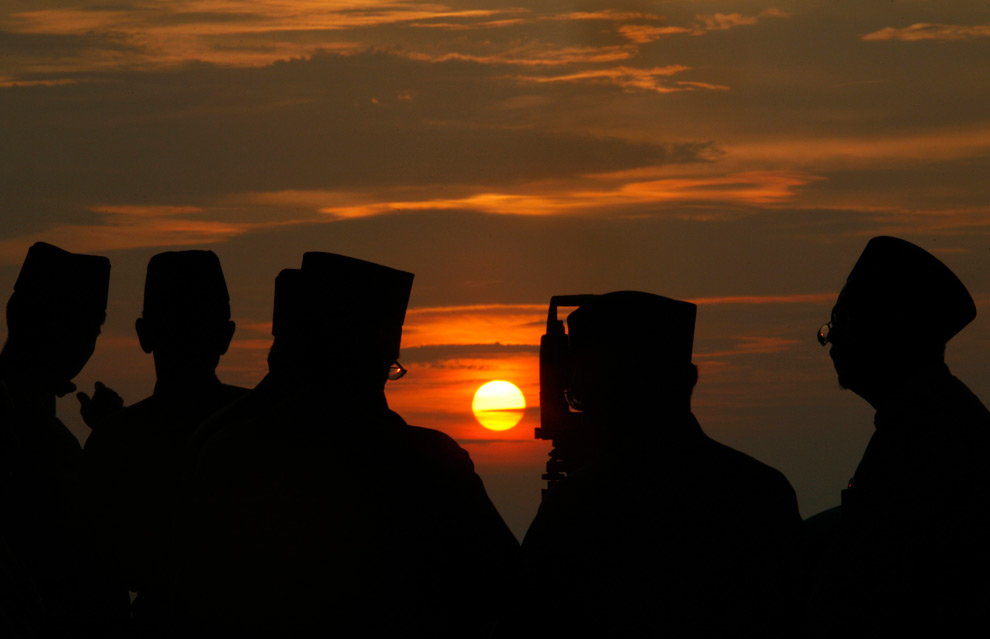
Officers of Malaysia's Islamic authority use a telescope to perform "rukyah", the sighting of the new moon of Ramadan, in Teluk Kemang, south of Kuala Lumpur, Malaysia on August 20, 2009. Muslims scan the sky at dusk in the beginning of the lunar calendar's ninth month in search of the new moon to proclaim the start of Ramadan, Islam's holiest month during which observant believers fast from dawn to dusk. (REUTERS/Bazuki Muhammad)
The word “Ramadan” is derived from "ramadha" which literally means "intense heat". There are a number of possible reasons for such a name including
When the Islamic months were enforced the month of fasting coincided with the summer months of intense heat
The second reason which has been mentioned is that due to fasting the temperature within the stomach increases, again the element of heat is a factor behind the actual naming of this month
It has also been said that "RAMADHAA" is one of the names of Allah (SWT). If that is the case then the month has acquired the name due to the fact that Allah (SWT) burns away accumulated sins and eliminates then from the list of unlawful deeds. Once again the burning sins cannonades "HEAT". However, it should be acknowledged that this reasoning is not wholly reliable
The month of Ramadan is a season of divine blessings, a month of purification and it is meant for annual renovation of inner-spiritual qualities. It is a golden opportunity for every Muslim to strengthen their imam, purify the heart and soul and remove the effects of sins. During this blessed month fasting is obligatory on all able-bodied Muslims and it is a time to maximize the acts of worship, minimize all mundane activities and refrain from all forms of sin. It is also recommended that one performs Umrah once on any one day of the month as this is a sunnah of the Holy Prophet (SAW).
SIGNIFICANT EVENTS
Hasan (RA), the grandson Holy Prophet (SAW) was born on the15th of Ramadan, three years after Hijri
The Holy Qur'an was revealed on the 27th night of Ramadan from the "Lauhe Mahfooz" (the 7th heaven) to the 1st heaven
The first battle in Islamic History, the Battle of Badr, took place on the 12th of Ramadan in the year 2 AH
Victory of Makkah took place on the 18th of Ramadan in the year 8 AH
Sawdah (RA) married the Holy Prophet (SAW) in year 10 AH
Zainab Bint Khuzaima's (RA) married the Holy Prophet (SAW) in the year 3 AH
On some of the benefits of Ramdhan
Allah said in the Qur'an in Surah Al-Baqarah
"Ramadan is the (month) in which was sent down the Qur'an, as a guide to mankind, also clear (signs) for guidance and judgment (between right and wrong)."( Al-Baqarah 2:185)
Abu Huraira related that the Prophet (SAW) said
“If anyone omits his fast even for one day in Ramadan without a concession or without being ill, then if he were to fast for the rest of his life he could not make up for it.” [Bukhari]
Abu Huraira related that the Prophet (SAW) said that Allah (SWT) the Majestic and Exalted said
“Every deed of man will receive ten to 700 times reward, except Sawm (fasting), for it is for Me and I shall reward it (as I like). There are two occasions of joy for one who fasts: one when he breaks the fast and the other when he will meet his Lord.” [Muslim]
The last third of Ramadan is the time for the release from Hell-fire, as the Prophet (peace and blessings be upon him) said in the Hadith reported by Salman Al-Farisi:
"O people, a great and a blessed month is approaching you. In this month there is a night that is better than one thousand months. Allah has made fasting during its daytime obligatory and prayers at night commendable during this month. Whosoever will do a voluntary good deed during this month, it is as if he performed an obligatory good deed at another time and whosoever will perform an obligatory good deed, it is as if he performed seventy obligatory good deeds at another time. This is the month of patience and the reward of patience is Paradise. This is the month of kindness and charity. In this month the believer’s provision is enlarged. Anyone who will give food to a fasting person in this month, it will bring forgiveness for his sins, will save him from the hellfire and he shall have his reward without the person who is fed losing any of his reward….The first third of the month of Ramadan is the time for Rahmah (Mercy), the second third is for forgiveness, the third is for the release from Hellfire…"
A Pakistani Muslim arranges food stuff for Iftar, a time to break the fast, on the first day of Ramadan, as a child looks on at a mosque in Karachi, Pakistan on Sunday, Aug. 23, 2009. (AP Photo/Fareed Khan)
Hooow cute, and just how gigantic are those serving bowls! :-D
I came across this article a few days ago and what amazed me the most was when I learned how blessed this month actually is. Do read.
DEFINITIONThe word “sha’baan is derived from the word "shu'ba", which means branch and itself means consecutively escalating or undisturbed increase. The Arabs used to branch out during this month to look for water.
The Arrival of the Sha’baan moon brings with it numerous blessings. Just as the initiation of rainfall begins with "pitter patter" such blessings reach us in the same accord and fashion. These blessings progressively escalate throughout the month so that by the middle of the month they have reached a considerable amount, reaching their peak by the end of Ramadan.
Just as a farmer prepares for a fruitful harvest by harrowing his acreage so that the soil may readily retain water; in contrast our souls are geared by the presence of such blessings in Sha’baan effectively preparing us for a fruitful and completely advantageous Ramadan. The Holy Prophet (SAW) has said,
"Sha’baan is my month and Ramadan the month of Allah Ta'aalaa." [Daylami]
The month of Sha’baan is one of the meritorious months in the Islamic calendar and it is reported in an authentic hadith that the Holy Prophet (SAW) used to fast most of this month. Although these fasts are not obligatory, Sha’baan is the month immediately preceding the month of Ramadan, therefore some preparatory measures are suggested by the Holy Prophet (SAW) through his sunnah and his practices.
The blessed companion Anas (RA) reported that the Holy Prophet was asked
“Which fast is the most meritorious after the fasts of Ramadan” he replied “Fasts of Sha’baan in honour of Ramadan”
The blessed companion Usama ibn Zaid (RA) reported that he asked the Holy Prophet (SAW)
“O Messenger of Allah (SAW), I have seen you fasting in the month of Sha’baan so frequently that I have never seen you fasting in any other month” he replied “That (Sha’baan) is a month between Rajab and Ramadan which is neglected by many people. And it is a month in which an account of the deeds (of human beings) is presented before the Lord of the universe. So I wish that my deeds be presented at time when I am in a state of fasting”
Ummul Mu’mineen ‘Aishah said
“The Holy Prophet (SAW) used to fast in the whole of Sha’baan.” I said to him “Messenger of Allah (SAW), is the month of Sha’baan your most favourite month to fast?” He said “In this month Allah (SWT) prescribes the list of the persons dying this year. Therefore, I like that my death come to me when I am in a state of fasting.”
In another tradition she said
“The Holy Prophet (SAW) would sometimes begin to fast continuously until we thought he would not stop fasting, and sometimes he used to stop fasting until we thought he would never fast. I never saw the Messenger of Allah (SAW) fasting a complete month, except the month of Ramadan, and I have never seen him fasting in a month more frequently than he did in Sha’baan.”
In another report she said
“I never saw the Messenger of Allah (SAW) fasting in a month so profusely as he did in the month of Sha’baan. He used to fast in that month leaving only a few days, rather, he used to fast almost the whole of the month.”
Ummul-Mu’mineen Umm Salmah said
“I never saw the Messenger of Allah (SAW) fasting for two months continuously except in the months of Sha’baan and Ramadan.”
These ahadith indicate that fasting in the month of Sha’baan, though not obligatory, is so meritorious, that the Holy Prophet (SAW) did not like to miss them. It should be kept in mind that the fasts of this month are for those persons only who are capable of keeping them without causing deficiency to the obligatory Ramadan fasts. The Holy Prophet (SAW) has also forbidden Muslims from fasting one or two days prior to the commencement of Ramadan. Abu Hurairah reported the Holy Prophet (SAW) said,
“Do not fast after the first half of the month of Sha’baan has gone.”
According to another report, the Prophet (SAW) said,
“Do not precede the month of Ramadan with one or two fasts.”
In essence, the Holy Prophet (SAW) himself used to fast most of the month of Sha’baan, because he had no apprehension of weakness or weariness before the month of Ramadan. As for others, he ordered them not to fast after the 15th of the month for the feat that they would lose their strength and freshness before Ramadan started and as a result would mot be able to welcome the month with enthusiasm.
The notion of fasting on the 15th day of this month with is referred to as “shabee baraat,” and standing in voluntary prayer during the night, is an innovation which has no religious significance associated with it.
A significant event that occurred during this month was the change in the direction of salat. Bukhar reported that Al-Bara said the Prophet prayed facing Bait-ul-Maqdis in Jerusalem for sixteen or seventeen months but he wished that his Qiblah would be the Ka'ba. Allah (SWT) revealed the following Qu’ranic verses
“Verily! We have seen the turning of your (Muhammad's (SAW)) face towards the heaven. Surely, We shall turn you to a Qiblah (prayer direction) that shall please you, so turn your face in the direction of Al-Masjid- al-Harâm (at Makkah). And wheresoever you people are, turn your faces (in prayer) in that direction. Certainly, the people who were given the Scriptures (i.e. Jews and the Christians) know well that, that (you’re turning towards the direction of the Ka'bah at Makkah in prayers) is the truth from their Lord. And Allah (SWT) is not unaware of what they do.” (Al-Baqarah 2:144)
The Holy Prophet then offered 'Asr prayers (in his Mosque facing Ka'ba at Makkah) and some people prayed with him. A man from among those who had prayed with him, went out and passed by some people offering prayer in another mosque, and they were in the state of bowing. He said, "I, (swearing by Allah (SWT),) testify that I have prayed with the Prophet (SAW) facing Makkah." Hearing that, they turned their faces to the Ka'ba while were still bowing. Some men had died before the Qiblah was changed towards the Ka'ba. They had been killed and we did not know what to say about them (i.e. whether their prayers towards Jerusalem were accepted or not). So Allah (SAW) revealed
“And Allah would never make your faith (i.e. prayer) to be lost (i.e. your prayers offered (towards Jerusalem). Truly Allah is Full of Pity, Most Merciful towards mankind.” (Al-Baqarah 2:143)
SIGNIFICANT EVENTS
1. "Qibla" the direction to be adopted within salaah, was reverted back to the "Ka'aba" in Makkah (after being converted to Baitul Muqaddas in Jerusalem for a short period of time). This took place two years after Hijrion the 15th of Sha’baan
2.Fasting in the blessed month of Ramadan was made compulsory in the year 2 AH on the 25th of Sha’baan
3.Hafsa (RA) was joined in matrimony with the Prophet (SAW) in 3 AH
4.Hafsa (RA) took leave from this world in 45 AH
5.Hussain (RA), the grandson of the Prophet's (SAW) was born, four years after Hijri on the 5th of Sha’baan
6.The Battle of Banu Mustaliq took place in Sha’baan during which, the "Aayah of Tayammum" (purifying with sand before salaah) was revealed, in the year 5 AH
7.The daughter of the beloved Prophet (SAW) Umme Kulthum (RA) took leave from this world, in the 9 AH